The following post will cover how and why sound was created and used in this project.
Website:
The first sound that was added to the timeline for the introductory video for the website, was the social media videos with the topic of ADHD. The volume levels were increased because the plan was to keep the first half of the video quiet and use the shock of the sudden increase in sound to gain the attention of the audience if they get distracted (Dickinson, 2021).
The second sound added to the timeline was the pop up sound when the videos popped up and when they disappeared. Research suggests that by using sound effects in educational videos, motivation and engagement is increased (de la Mora Velasco, Hirumi and Chen, 2021).
The third sound added was the multiple voice recordings and ear ringing sound. The multiple voice recordings are a mental manifestation of restlessness; a very common symptom of ADHD (Rachel, 2023). Often people with ADHD feel as though they have multiple trains of thought happening in their head at once, making day to day life overwhelming.
When the sound was added, it felt as though it was a bit sudden in volume, and it was decided to have the sound increase, to represent how people with ADHD get increasingly overwhelmed.
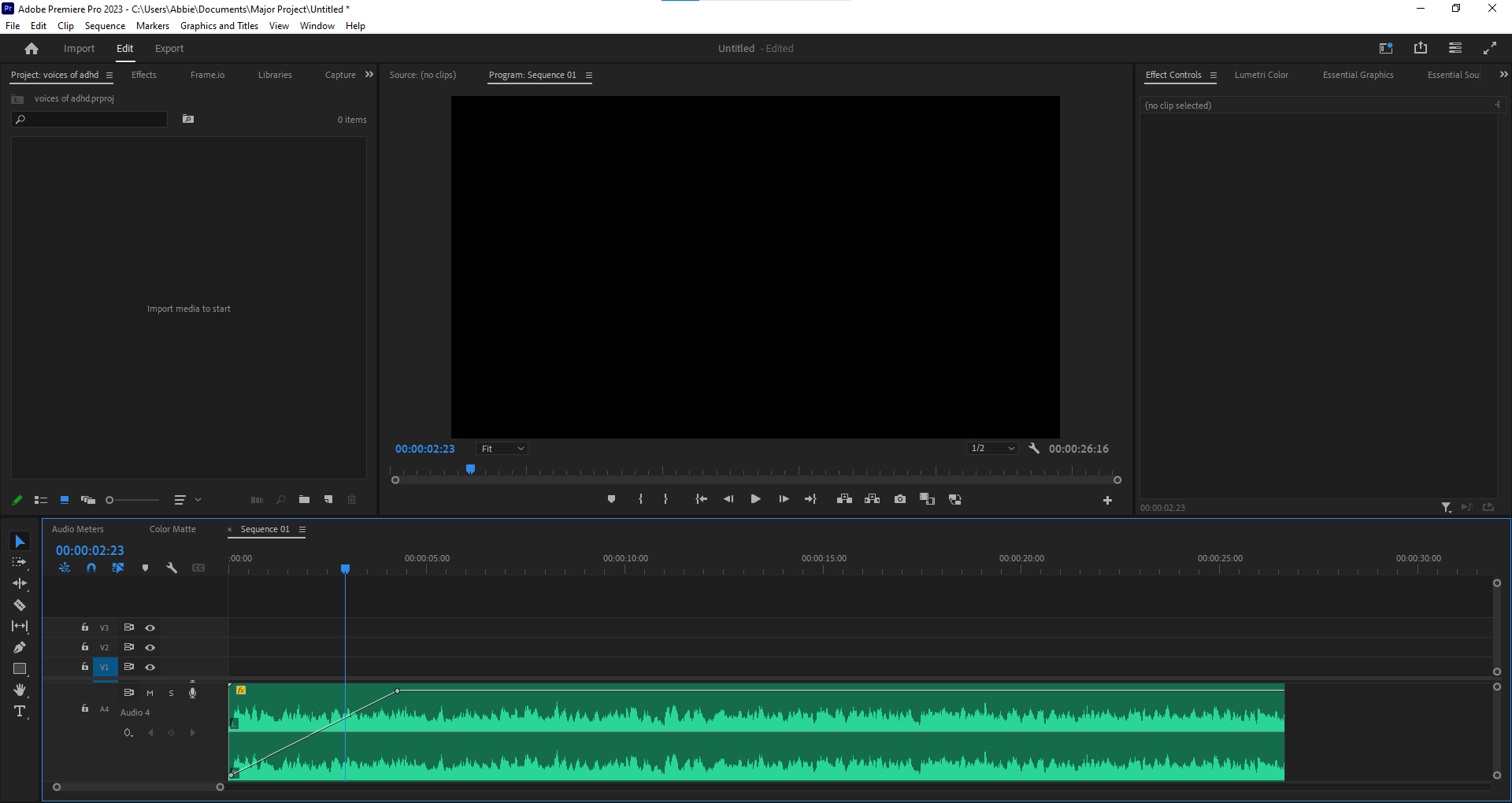
The ear ringing sound represents sensory overload (hyperacusis) that people with ADHD often experience (ADDtitude, 2024). The ear ringing (tinnitus) often causes people to experience hyperacusis (Hebert, Fournier and Norena, 2013), which is the closest sound accessible to recreate the feeling of sensory overload.
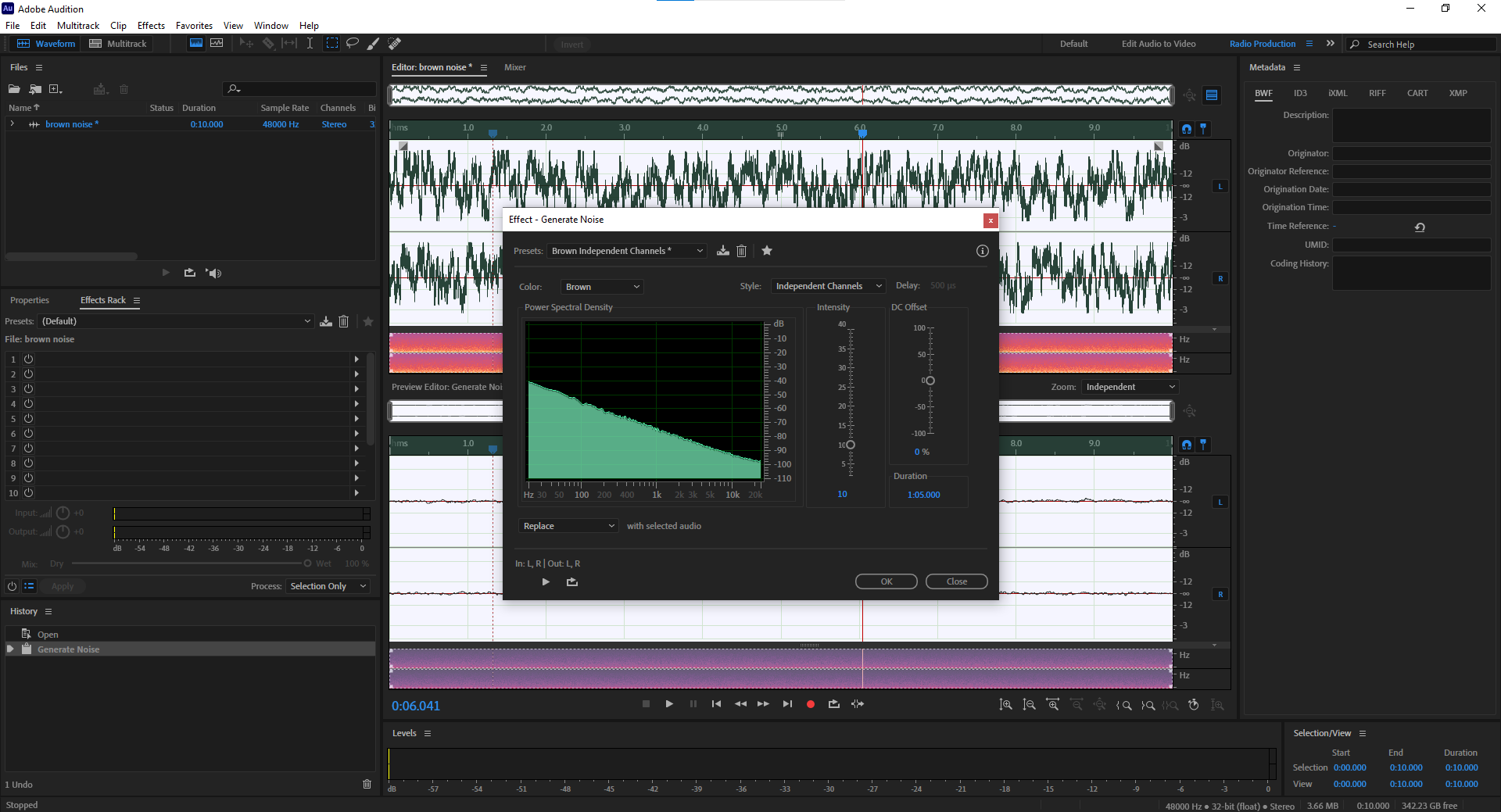
When watching the video back following adding the above sound, it seemed too quiet at the beginning, which led to research into what background noise would be best for this video. Following this, an article was found that discussed the benefits of brown noise for attention, especially for those with ADHD (Team, 2023).
The brown noise sound effect was then created using Adobe Audition, with the volume altered to make the noise more ambient to the video.
Animation and ADHD Simulator:
For the animation all of the sounds originated from the voice over script recorded in Character Animator with the animation of the ADHD brain. This was recorded via microphone while the webcam captured face and eye movements, which was then automatically animated by the program.
Social Media Advertisement:
For the social media advertisement ‘POV: You’ve just woken up with ADHD’, a combination of different voice recordings, including speech and humming was used with the ear ringing sound effect. Like with the website sounds, the ear ringing sound effect was used as representation of sensory overload.
Reference list
ADDtitude (2024). How Adults with ADHD Think: Understanding the Neurology of ADD. [online] www.additudemag.com. Available at: https://www.additudemag.com/adhd-in-adults-nervous-system/#:~:text=Many%20people%20with%20ADHD%20can [Accessed 30 Apr. 2024].
De la Mora Velasco, E., Hirumi, A. and Chen, B. (2021). Improving Instructional Videos with Background Music and Sound Effects: A Design-Based Research Approach. Journal of Formative Design in Learning. doi:https://doi.org/10.1007/s41686-020-00052-4.
Dickinson, M. (2021). Studies determine what sounds draw attention, how to pinpoint them. [online] Illinois.edu. Available at: https://ece.illinois.edu/newsroom/3182 [Accessed 30 Apr. 2024].
Hebert, S., Fournier, P. and Norena, A. (2013). The Auditory Sensitivity is Increased in Tinnitus Ears. Journal of Neuroscience, [online] 33(6), pp.2356–2364. doi:https://doi.org/10.1523/jneurosci.3461-12.2013.
Rachel (2023). Adult ADHD: Overthinking and Intrusive Thoughts. [online] Onebright. Available at: https://onebright.com/advice-hub/news/adult-adhd-overthinking-and-intrusive-thoughts/#:~:text=Racing%20thoughts%3A%20People%20with%20ADHD [Accessed 30 Apr. 2024].
Team, A.E. (2023). What Is Brown Noise and Can It Help People With ADHD? [online] ADDA – Attention Deficit Disorder Association. Available at: https://add.org/brown-noise-adhd/.