In this post the research obtained in previous posts, including from the proposal, will be re analysed and the relevance and how they apply to the assets that will be produced in the project, will be explained.
There will also be an explanation of the plan for each asset, including how it is linked to research.
Social Media Campaign
The analysis of previous campaigns highlighted that with similar campaigns, a video with a personal feel is more effective. The decision of creating a video that shows people what it is like to live with ADHD has previously been explained and when making the decision of real life vs animation for this aspect, people are more likely to connect with other people vs animation (Duncan J., 2015).
After careful consideration of the research, to ensure that the video can engage with the audience and allow them to get as close to experiencing ADHD as possible, the video will use audio and visual cues of an average day to show what is it like to have the condition. The video will be filmed from the POV (Point of View) of the person with ADHD.
Using the exploration of the condition and symptoms, several scenarios will appear within the video to represent the symptoms. For example, to show the symptom of inattentiveness, the video may show the camera angle change and the audio playing the thoughts may suddenly change subject.
Website, Animation and Still Images
The analysis of colour theory, typography and other techniques that are found to be helpful to combat the symptoms of ADHD will allow the user to focus on the important elements of the website, even if they struggle with ADHD.
Typography:
When looking for academic writing confirming the success of bionic reading, there is little research on the correlation of bionic reading and an increase of the information retained when reading in those with ADHD. Even though bionic reading have received feedback from those with ADHD that bionic reading improved their understanding when faced with large bulks of text (Bionic Reading, 2021), they do not give sample size, which can make any results questionable.
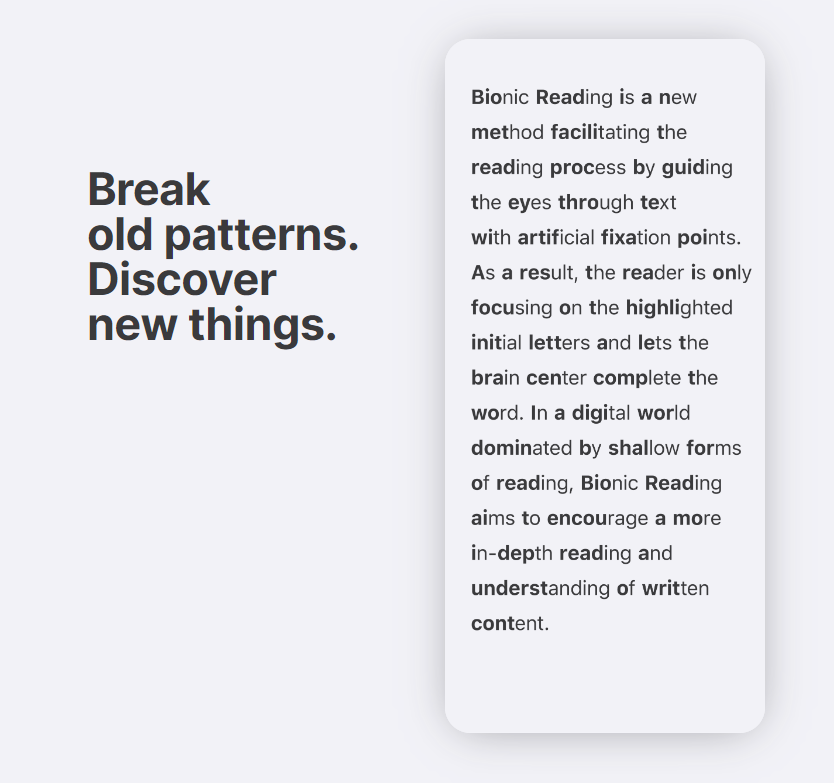
In support of bionic reading a study was conducted to determine the effect of bionic reading on an average student with learning disabilities; this found that there was a significant increase of reading motivation and comprehension (Xerxes B. et al., 2023). The study also recommends that if bionic reading is used as a method for those with limited concentration capacity, that the effectivity of it be monitored.
Considering the points above in relevance to bionic reading, it was determined that bionic reading be implemented into the website, and to regularly gain feedback from the users or potentially take the website into user testing before it goes live.
Colour Theory:
Following further research into how colour may impact the attention span in those with ADHD, research into colour perception and ADHD concluded that with a blue-yellow colour palette, people with ADHD encountered problems with colour perception (Banaschewski et al., 2005). This means that people with ADHD are likely to experience an impairment of stimuli due to having a deficient level of retinal dopamine (Tannock, Banaschewski and Gold, 2006).
It was then questioned as to whether an impaired colour perception would impact the users of the website in correlation of what the website aims to do. Following further research, a research article found a strong link between attention span and colour perception in those with ADHD (Jadhao et al., 2020). They found that with weakened colour perception, people with the condition had a shorter attention span and there was a negative influence on short term memory. This research is further confirmed by an article titled ‘Virtual environment to quantify the influence of colour stimuli on the performance of tasks requiring attention’, which observes how colour perception can impact attention in a virtual world (Silva and Frère, 2011).
The results of the research all pointed towards the same conclusion; that colour perception is significantly improved using a red/green colour palette, in both written tasks and in a virtual world for those with ADHD, and that colour perception difficulties negatively impacts attention span and short term memory.
Following exploration of this research, it was decided that the colour palette initially produced needed to be reconsidered, and that a red/green colour palette would be beneficial to this project and its recipients.
The updated colour palette will be revealed in the ‘alterations to initial concept’ post.
Reference list
Banaschewski, T., Ruppert, S., Tannock, R., Albrecht, B., Becker, A., Uebel, H., Sergeant, J.A. and Rothenberger, A. (2005). Colour perception in ADHD. Journal of Child Psychology and Psychiatry, 47(6), pp.568–572. doi:https://doi.org/10.1111/j.1469-7610.2005.01540.x.
Bionic Reading (2021). Faster. Better. More focused. Reading. [online] Bionic Reading. Available at: https://bionic-reading.com/.
Duncan, J. (2015). Animation or Real People in Your Online Video: Which is More Effective? [online] Social Media & Influencer Marketing Speaker, Consultant & Author. Available at: https://nealschaffer.com/animated-videos-real-people-online-video/.
Jadhao, A., Bagade, A., Taware, G. and Bhonde, M. (2020). Effect of background color perception on attention span and short-term memory in normal students. National Journal of Physiology, Pharmacy and Pharmacology, 10(11), p.1. doi:https://doi.org/10.5455/njppp.2020.10.06162202017072020.
Silva, A.P. and Frère, A.F. (2011). Virtual environment to quantify the influence of colour stimuli on the performance of tasks requiring attention. BioMedical Engineering OnLine, 10(1), p.74. doi:https://doi.org/10.1186/1475-925x-10-74.
Tannock, R., Banaschewski, T. and Gold, D. (2006). Color naming deficits and attention-deficit/hyperactivity disorder: A retinal dopaminergic hypothesis. Behavioral and Brain Functions, 2(1), p.4. doi:https://doi.org/10.1186/1744-9081-2-4.
Xerxes, B., Capuno, R., Cañete Pinili, L. and Añero, M. (2023). The Impact of Bionic Reading on the Reading Motivation and Self-Efficacy of Students with Learning Disabilities. INTERNATIONAL JOURNAL OF ADVANCED MULTIDISCIPLINARY STUDIES , [online] Volume III(Issue 10), pp.402–416. Available at: chrome-extension://efaidnbmnnnibpcajpcglclefindmkaj/https://www.researchgate.net/profile/Xerxes-Budomo-2/publication/379144111_The_Impact_of_Bionic_Reading_on_the_Reading_Motivation_and_Self-Efficacy_of_Students_with_Learning_Disabilities/links/65fc5397d3a08551423a2ccb/The-Impact-of-Bionic-Reading-on-the-Reading-Motivation-and-Self-Efficacy-of-Students-with-Learning-Disabilities.pdf [Accessed 18 Apr. 2024].