This post aims to find and define the target audience and explore the competition within the market, to potentially gain insight into how to run a campaign of this nature.
Who is the target audience for this campaign?
When determining the target audience for this project, it can be difficult because without the data found through the users accessing the website (normally provided through Google Analytics (Google Marketing Platform, 2019)), it can be difficult to get details on who the target audience is and their behaviours.
To gain a better insight into predicting the likely target audience, data on the incidence of ADHD depending on age group could be considered.
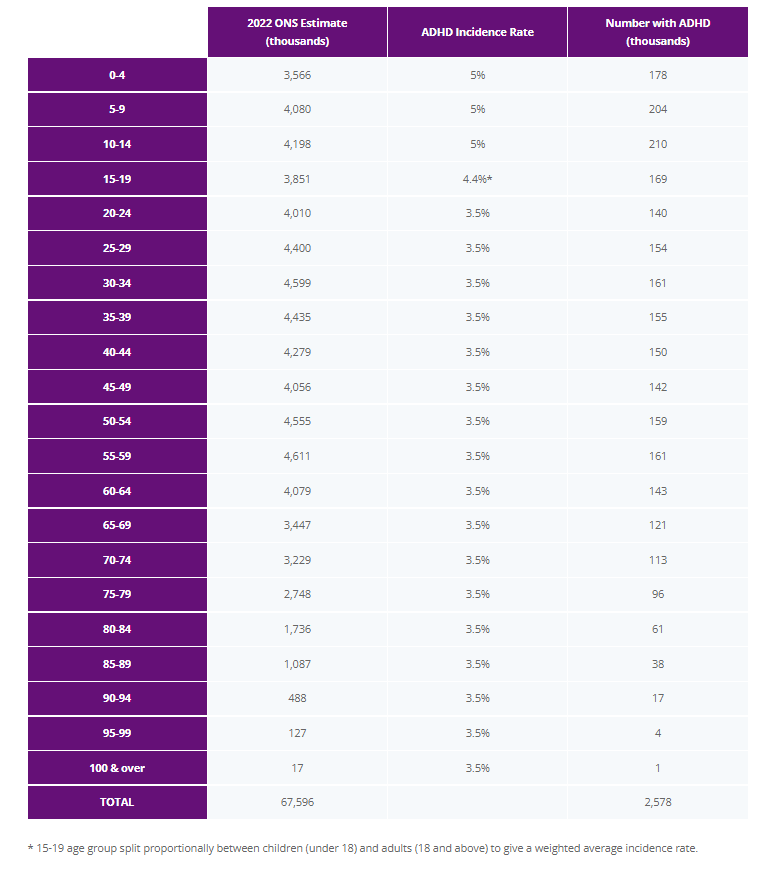
Although the incidence of ADHD is higher in those under 19, it seems unlikely that children would be looking to educate themselves on the condition and more likely that the parents/carers would like a better understanding on how to care for someone with ADHD.
In terms of the characteristics of the target audience, it is estimated that over 2 million people in the UK are struggling with ADHD without being aware of the condition (ADHD UK, 2023). Combining that with the over 2.5 million people with a diagnosis, it is likely that the majority of the population in the United Kingdom either have the condition or know someone who has it (regardless of diagnosis).
Through attempting to determine the target audience for this campaign, it appears that although the age demographic should be aimed at the over 16, the behaviours and characteristics of the target audience can not be narrowed down to specifics.
It has been determined that the target audience will best fit those 16 and over, with the aim to educate on ADHD.
The target audience for this project can be narrowed down into two categories; Those with ADHD (or awaiting diagnosis) over the age of 16, and the friends and families of those with ADHD (or awaiting diagnosis).
The awaiting diagnosis portion of the target audience has been included due to the extreme waiting times currently facing the UK for ADHD diagnosis (ADHD UK, 2023).
How have similar campaigns been executed?
When researching similar campaigns that has the aim of educating on a condition, it was noted that there are very few that focus primarily on ADHD and so, it was decided to widen the scope and analyse the campaigns with the same aims but different conditions.
The first campaign that appeared to have an impact is the ‘Suicide Doesn’t Always Look Suicidal’ campaign by CALM (Campaign Against Living Miserably).
Another campaign by Norwich City Football Club that is currently very popular on social media, due to the strength of their message is the ‘You Are Not Alone’ campaign.
There are two campaigns that covered autism which stood out significantly because they are designed in a way to help the view understand and experience the condition through visual and audio cues that show how someone with autism experiences the world.
The first is by Vanish, they use their platform to not only advertise their product, but also educate on the lack of diagnosis in autistic girls and women. They won a Diversity in Advertising Award in conjunction with Channel 4.
The final campaign is from The National Autistic Society and is named ‘Can You Make it to the End?’.
These campaigns all use similar methods to evoke emotion in their audience to encourage them to get more informed about the conditions they are aimed at. The two aimed at suicide have the aim of educating to avoid future loss of life, allowing the audience to view those appearing in the video as someone looking in rather than encouraging the audience to feel what they were feeling. They use a shock factor as the video nears the end, likely because it will make the video more memorable (NG Production Films, 2018).
Alternatively, the two aimed at autism appear to have the aim of educating to evoke understanding and empathy towards the condition. They use a series of audio and visual cues as a method of showing the audience what someone with autism experiences on a daily basis, allowing the audience to empathise with them and potentially look for further information.
In terms of the best method to use for this project, although recent articles have found strong links with ADHD and suicide attempts (Balazs J. et al., 2017), there are no set statistics confirming the rate of incidence. As there is no set data to confirming a commonality between ADHD and suicide, it is likely that the video to encourage the audience to the website will be more successful if it shares the experience of ADHD rather than using a shock factor.
Reference list
ADHD UK (2022). ADHD Incidence | ADHD UK. [online] ADHD UK. Available at: https://adhduk.co.uk/adhd-incidence/.
ADHD UK (2023). ADHD Diagnosis Rate UK – ADHD UK. [online] ADHD UK. Available at: https://adhduk.co.uk/adhd-diagnosis-rate-uk/.
ADHD UK (2023). NHS ADHD Assessments Waiting Lists Report. [online] adhduk.co.uk. Available at: https://adhduk.co.uk/nhs-adhd-assessments-waiting-lists-report/.
Balazs, J. and Kereszteny, A. (2017). Attention-deficit/hyperactivity disorder and suicide: A systematic review. World Journal of Psychiatry, 7(1), p.44. doi:https://doi.org/10.5498/wjp.v7.i1.44.
CALM (2023). Suicidal Doesn’t Always Look Suicidal. [online] www.youtube.com. Available at: https://youtu.be/6Jihi6JGzjI.
Google Marketing Platform (2019). Analytics Tools & Solutions for Your Business – Google Analytics. [online] Google Marketing Platform. Available at: https://marketingplatform.google.com/intl/en_uk/about/analytics/.
NG Production Films (2018). ‘Look at That!’ How to Tastefully Use Shock Value in Your Video Production. [online] Orlando Video Production | Production Company Orlando | Video Crews. Available at: https://ngproductionfilms.com/look-at-that-how-to-tastefully-use-shock-value-in-your-video-production/.
The National Autistic Society (2019). Can you make it to the end? YouTube. Available at: https://www.youtube.com/watch?v=aPknwW8mPAM.
Vanish (2023). Me, My Autism & I | Vanish & Ambitious about Autism | Hero Film. [online] www.youtube.com. Available at: https://youtu.be/4Xtog_zRRJg [Accessed 18 Apr. 2024].