Research Overview:
For this project the advancement in technology used for children’s books will be analysed and how augmented reality can be implemented into existing content will be tested.
Overview of the project:
For this project I will consider how technology has enhanced children’s books and entertainment and apply augmented reality and 2D animation to the book ‘The Very Hungry Caterpillar’ (Carle, 1969) to demonstrate how emerging technology can enhance already existing content.
What is augmented reality?
Augmented reality is an emerging technology that uses a computer generated image and layers it on top of a real world view, thus creating a combination of reality and virtual reality (Gillis, 2022). Augmented reality gives users the ability to not just imagine something is there, but actually see it as if it is. A more commonly known example of this is Pokemon Go (Pokemon, 2024). This is an app that was created for entertainment purposes that allows users to explore their reality, while looking for and catching Pokemon through augmented reality.
UX
When considering the why for this project, I considered why the use of AR might be needed for this project when a 2D animation of this story could be created without the use of AR. The reason AR would be useful for this project is because although the AR technology would allow the user to be able to see the animation, it still would require the user to read the story (Kataja , 2019). If I created an animation for this project without AR, it would have to either have narrated text or use an average reading time to allow the user to read the text. This does not account for those with higher or lower reading abilities. By using an average those with lower abilities have too few time to read the text and those with higher abilities will have too much time to wait between scenes which can cause disengagement. By using AR, the user has complete control of the time they spend on each page, which allows them to read the text and watch the animation at their own pace.
UX design is extremely important in children’s books to facilitate interaction for the user and create a flow of illustration and words to tell a story (Luscan (Jumara), 2023). For example in the book ‘ The very hungry caterpillar’ the author uses bright colours and an engaging story to not only educate children on how a caterpillar can turn into a butterfly, but according to the author, a story on how something small and insignificant can unfold its talent and fly into the world (Maynard, 2016). Carle uses interactive methods UX design in this book, evidenced by the holes they placed in the visuals of the fruit to show the caterpillar eating the fruit. This creates an engaging and interactive experience for the children that used the technology that was readily available at the time.
For this project, I will be imagining how Carle could have used emerging technologies to create an interactive experience with this book if it had been created in 2024.
Ethical Considerations:
The main ethical consideration for this project is the subject of copyright. For this project I will ensure to be clear that the work produced is simply a proof of concept, using existing work to test the viability of this project. I am simply testing if augmented reality can be a viable option in storytelling, not only in existing work but in new releases of children’s storybooks in the future.
Another ethical consideration is accessibility. This project requires users to have access to the technology required to use it. The technology for the AR proportion of this project will be tested using Adobe Aero, but used by customers on an app specific to the book. 98% of adults currently have a mobile phone (Mobile UK, 2013), making this product available to the vast majority.
Another consideration is the use of ads by the app provider. If the app uses ads to create revenue there is the potential to open the consumer up to cybercrime and inappropriate ads. This can be managed by finding alternative methods of revenue (Such as a subscription service or one off payment for the app) or by closely monitoring what ads are played in the app and how often.
Project Plan and Task Management:
For this project I plan to create animations using the story of the very hungry caterpillar and use Adobe Aero to test if AR can be used to enhance the UX of an existing book. I will start by considering how the character will move and how each scene will be created with a simple storyboard, and then use Procreate to create the initial visuals for the animations. I will then move the still images to Adobe Animate and add motion and the text to each scene. I will then export the scenes at a PNG sequence with alpha to allow the animation to be imported to adobe aero as a sequence, then I will use the software to anchor the animation to the background image, creating an AR effect when the camera is placed over the background. I will then reflect on this project and consider what aspects of the project went well and what aspects could be improved upon. For this project I created a Gantt chart to monitor key milestones and allow myself an allotted timeframe for each milestone.
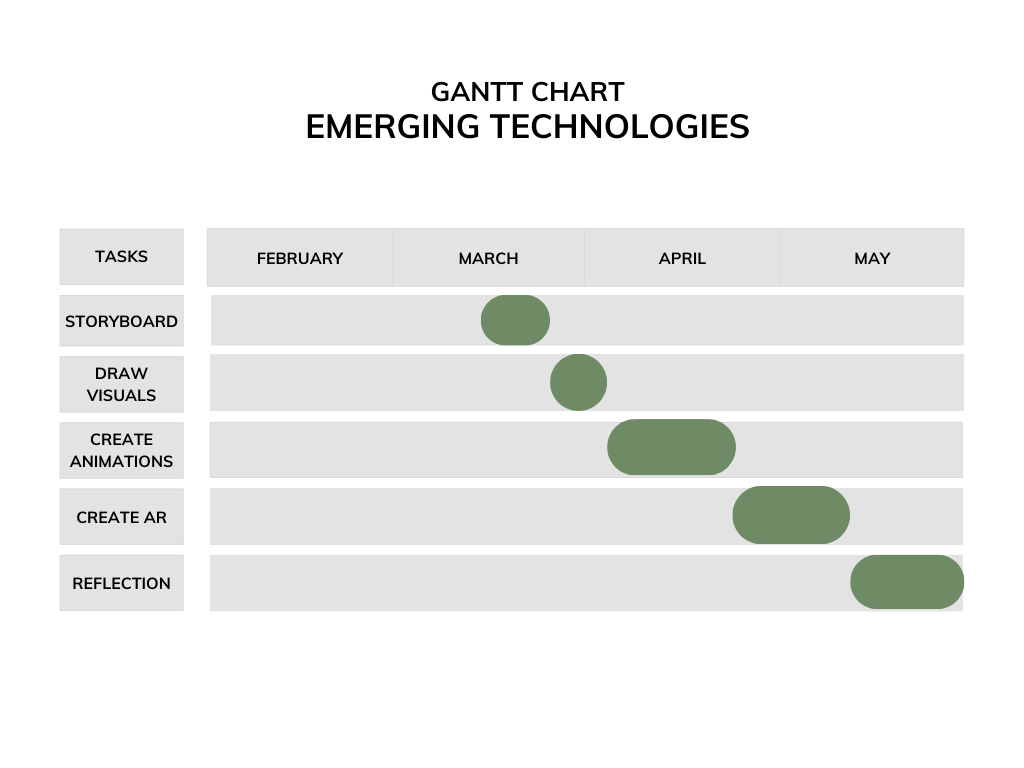
I then used the Gantt chart to create a task management board, showing the individual task involved for each key milestone for this project.
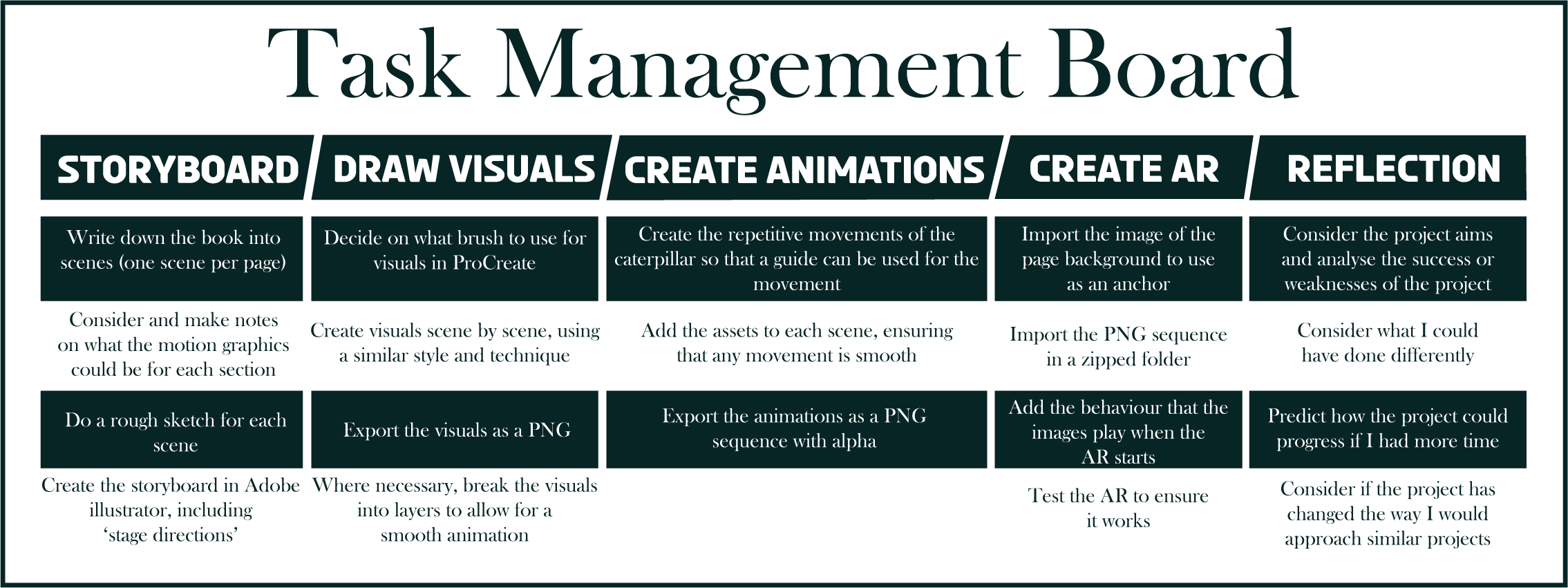
By splitting each key milestone into smaller task it will add a sense of organisation to my project and assist in keeping me on track with the workload.
Scrum User Stories:
A scrum user story is a method mainly used in software development to determine the individual needs of the end user in small task format (Arun, 2023). They normally use the format ‘As a [role], I [want to], [so that].’. This method encourages consideration of the who, what and why for the end user, allowing a more person centred approach for UX design. Examples of user stories for this project could be:
“As a parent, I want a book for my child that uses technology to increase engagement, so that my child is learning and interested.”
“As a parent, I want a simple to use app, so that I can spend more time with my child and less time trying to understand how to make things work”.
“As a teacher, I want to be able to combine reading and technology, so my students reading and computer/technology skills are improved.”
From receiving the user stories, they are then discussed with the Stakeholders and it is decided which of these will be actioned. The wireframes/storyboards are then created and confirmed with the end-user(s), and the end user(s) will review the content throughout creation and give feedback in relation to their goals. If there is any further feedback from the user regarding alternate needs, a new user story is created and the process begins again (Arun, 2023).
User stories assist in helping keep focus on exactly what the end-users needs are, which in turn creates a greater user experience.
Storyboard:
Following dividing the book into scenes, I created a rough storyboard for the AR elements of this project.
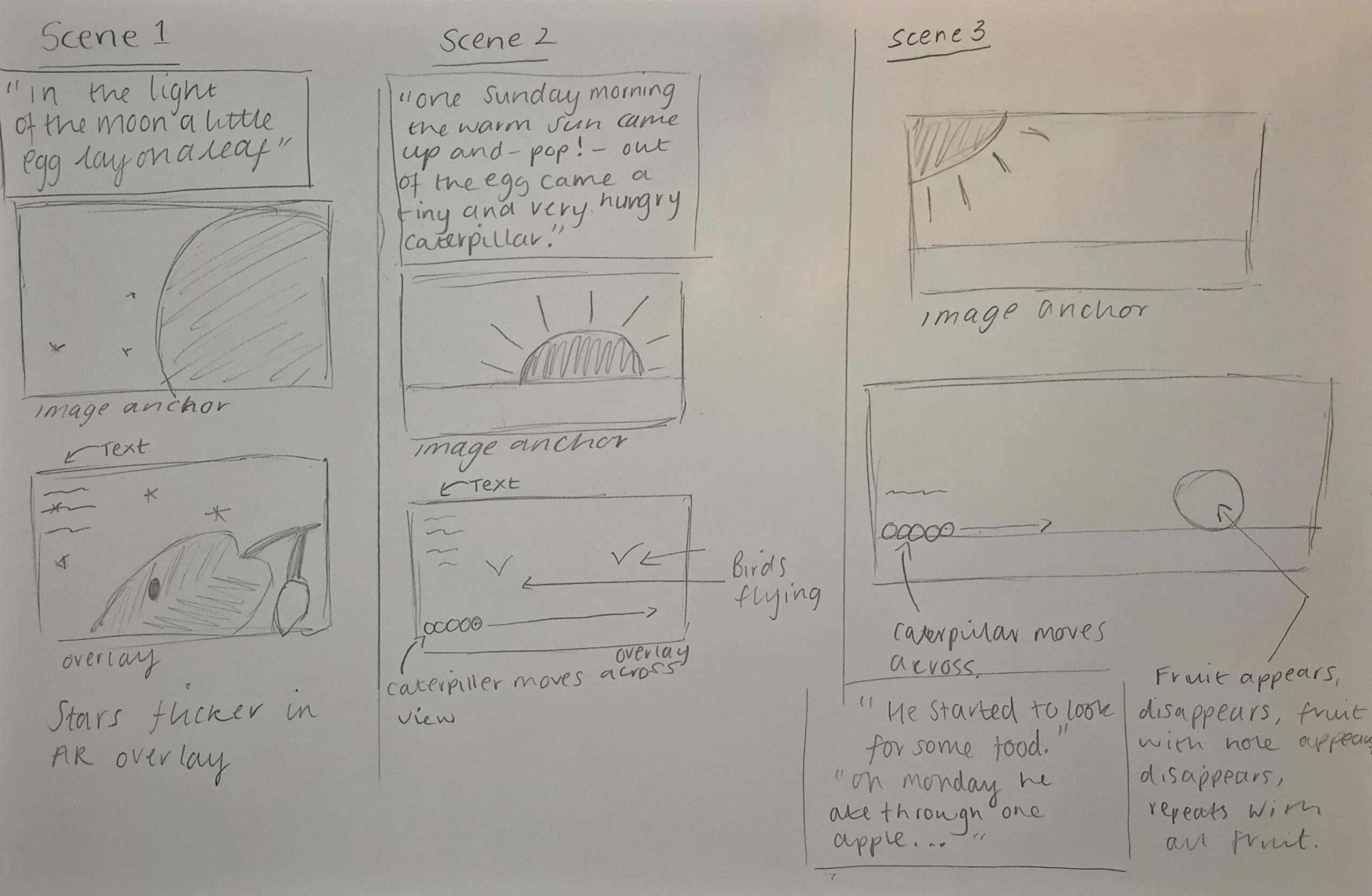
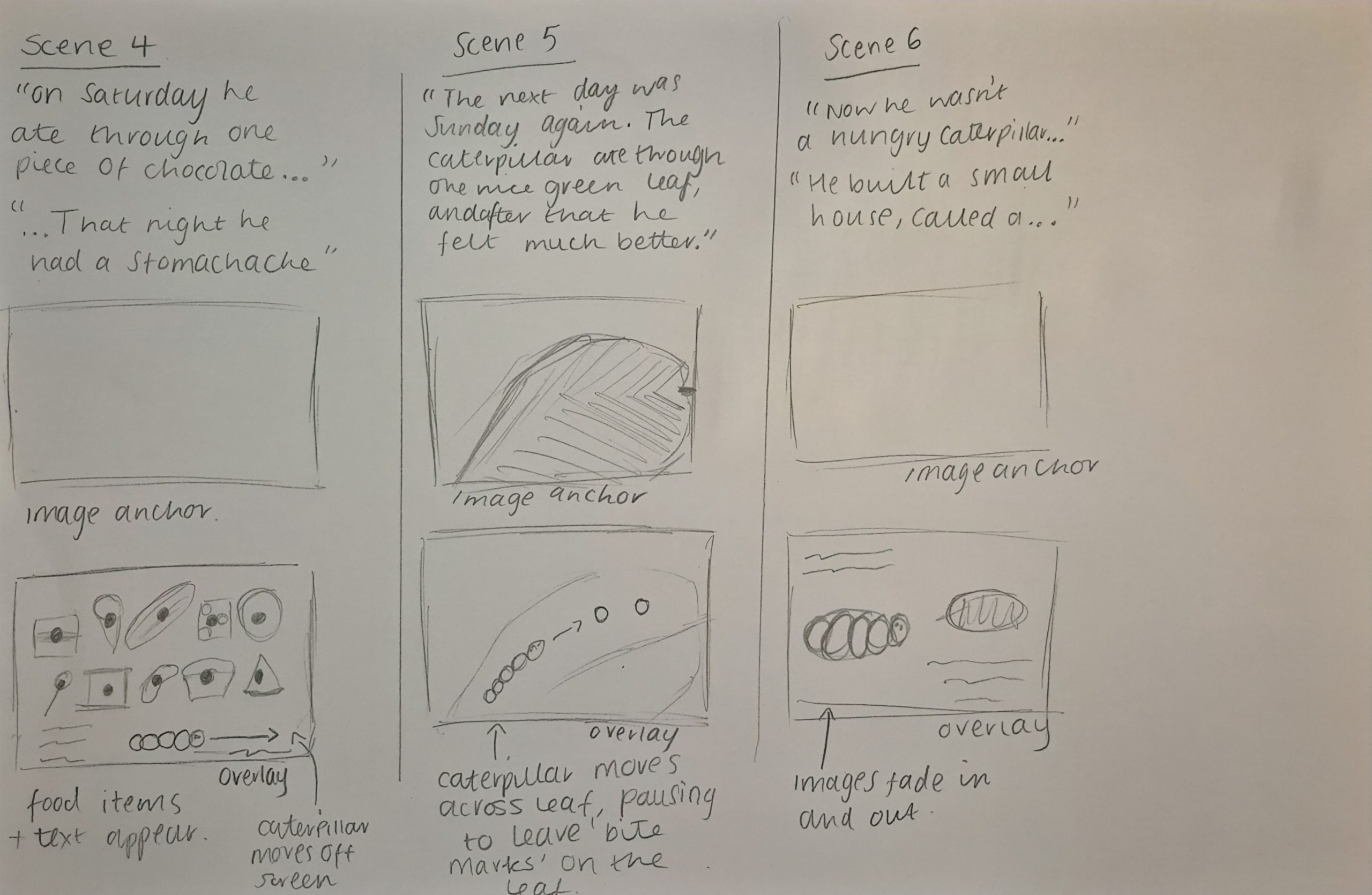
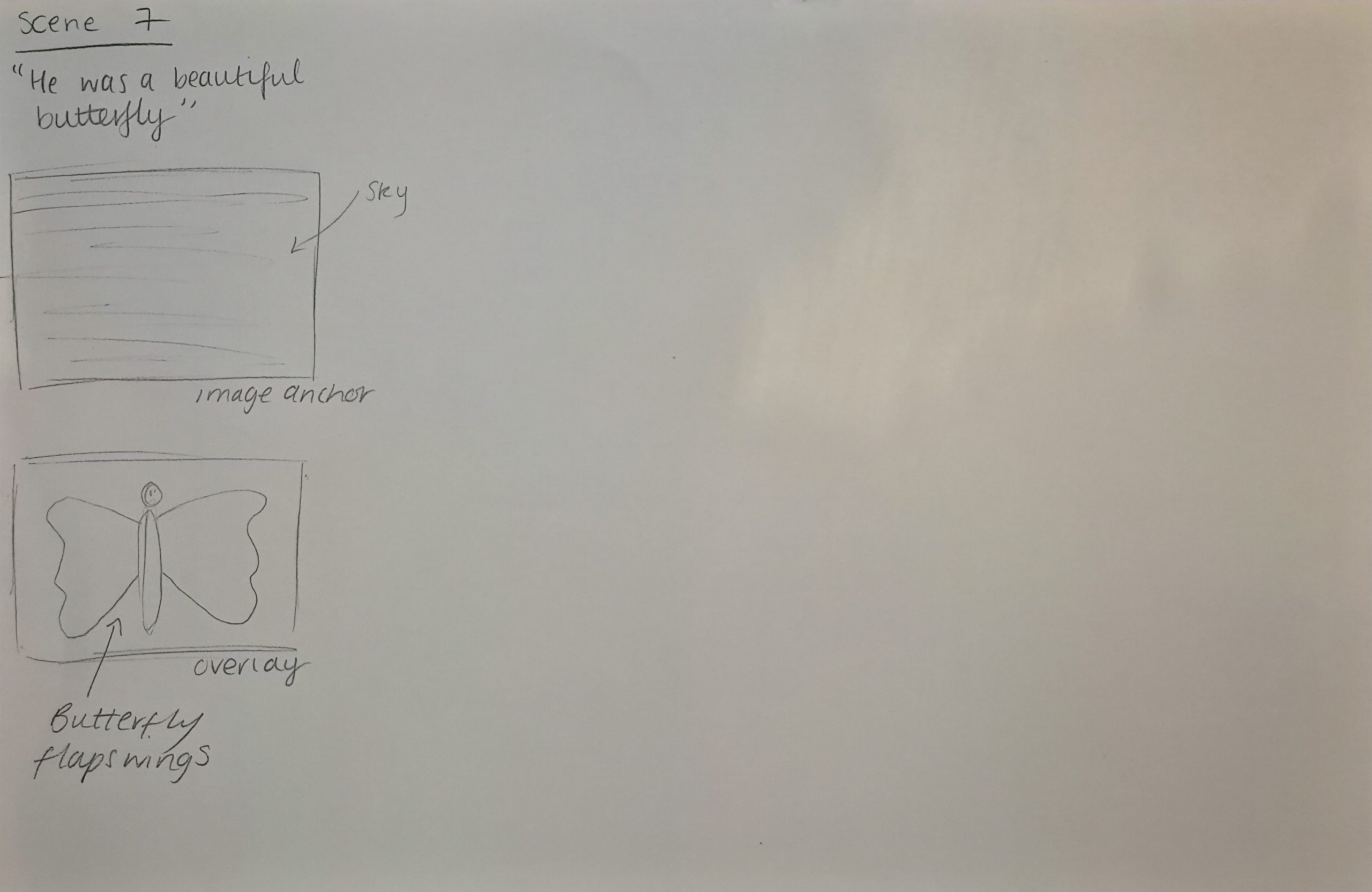
Through research into AR and how it has been linked with children’s books previously, and by following the plan detailed in this proposal, I will be able to successfully complete my project and evidence how AR can be used to enhance existing content.
Reference list
Arun, R. (2023). An Introduction to the World of User Stories [Updated]. [online] Simplilearn.com. Available at: https://www.simplilearn.com/tutorials/agile-scrum-tutorial/user-stories#what_are_user_stories [Accessed 18 May 2024].
Carle, E. (1969). The very hungry caterpillar. New York: Philomel Books.
Gillis, A. (2022). What Is Augmented Reality (AR)? [online] Tech Target. Available at: https://www.techtarget.com/whatis/definition/augmented-reality-AR.
Kataja , T. (2019). 2D Animation in the World of Augmented Reality .
Luscan (Jumara), L. (2023). What do UX writing and picture books have in common? [online] Medium. Available at: https://bootcamp.uxdesign.cc/what-do-ux-writing-and-picture-books-have-in-common-f67c7d880b5a [Accessed 18 May 2024].
Maynard, C. (2016). The Very Hungry Caterpillar. [online] Connor Maynard Design. Available at: https://cmaynardgraphics.wordpress.com/2016/02/18/the-very-hungry-caterpillar/.
Mobile UK (2013). Mobile Facts | Networks & Connectivity in the UK | Mobile UK. [online] Mobileuk.org. Available at: https://www.mobileuk.org/mobile-facts#:~:text=There%20are%20111.8%20million%20mobile.
Pokemon (2015). Discover Pokémon in the Real World with Pokémon GO! YouTube. Available at: https://www.youtube.com/watch?v=2sj2iQyBTQs.
Pokemon (2024). Pokémon GO. [online] Pokémon GO. Available at: https://pokemongolive.com/?hl=en.